The Ruby Cavalier King Charles Spaniel: A Complete Guide to the Breed's Rarest Color
By Villa Crest Puppies
There is a moment that happens reliably when someone sees a Ruby Cavalier King Charles Spaniel for the first time. They stop. They look. And then, almost always, they say some version of: I didn’t know this existed. And then they fall in love with it on the spot.
That moment never gets old.
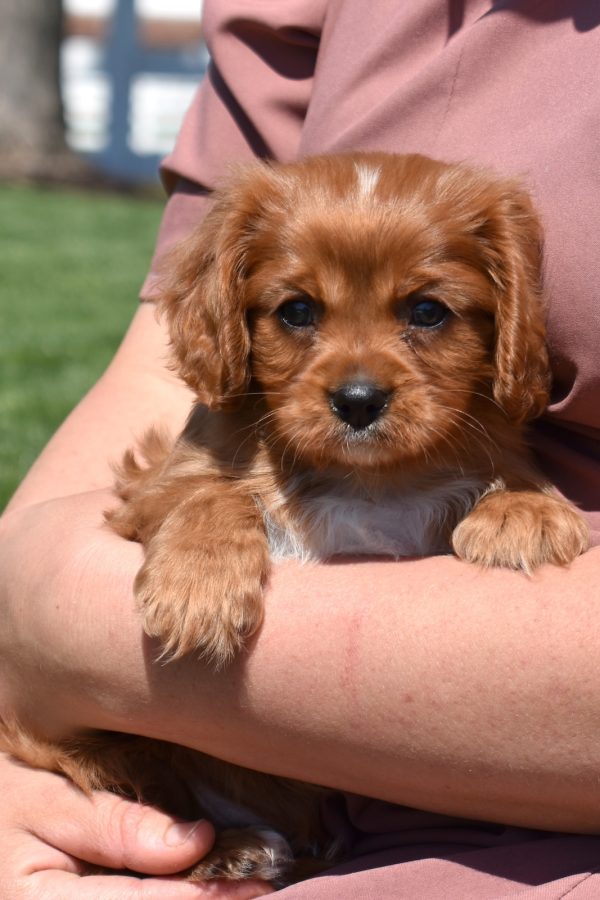
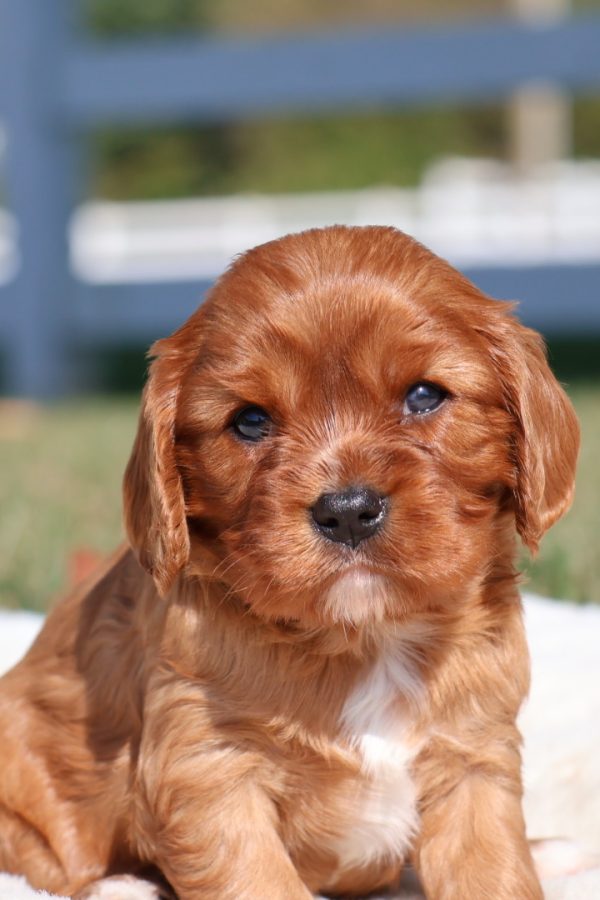
The Ruby is the least familiar of the four recognized Cavalier colors, and that unfamiliarity is a large part of what makes it so striking. While the Blenheim has become practically synonymous with the breed in the public imagination, the Ruby moves through the world more quietly — a whole-colored, deep mahogany dog without a single patch of white, carrying a warmth and richness in its coat that photographs genuinely struggle to capture. For the people who love Rubies, no other color comes close. For everyone else, a first encounter tends to be a conversion experience.
This guide is a thorough look at everything that makes the Ruby Cavalier King Charles Spaniel so special. We will cover its history and place within the breed, what the ideal Ruby looks like and how the color varies, the genetics behind the whole-color pattern, what to look for in a well-bred Ruby puppy, and the honest answers to questions we hear most often. If the Ruby has caught your eye — or if you are still deciding between colors — read on.
Navigation
Article Contents
Where The Ruby Fits In Cavalier History
The four Cavalier King Charles Spaniel colors are not arbitrary — they are the surviving expressions of the variety that existed in the small spaniel companions favored by the British aristocracy from the 16th century onward. King Charles II is most closely associated with the black and tan spaniels that bear his name, but solid red dogs appeared in the same royal circles and in the same aristocratic portraits. The whole-color reds were there from the beginning.
When the breed was formally re-established in the twentieth century — driven by the effort to restore the longer-nosed, more spaniel-like dogs seen in old royal paintings — all four colors were included in the breed standard. Ruby and Black and Tan were recognized as the whole colors alongside the parti-color Blenheim and Tricolor. They have remained part of the standard ever since.
What makes the Ruby’s position unusual is not its historical standing but its rarity in practice. Because the Blenheim is so dominant in terms of popularity and sheer numbers, Rubies are produced less frequently, sought out less often, and understood by fewer people. That dynamic is slowly changing as the internet gives enthusiasts a wider window into what is possible within the breed. But the Ruby remains, in most parts of the country, a genuine surprise to the average person who encounters one.
What A Ruby Cavalier Actually Looks Like
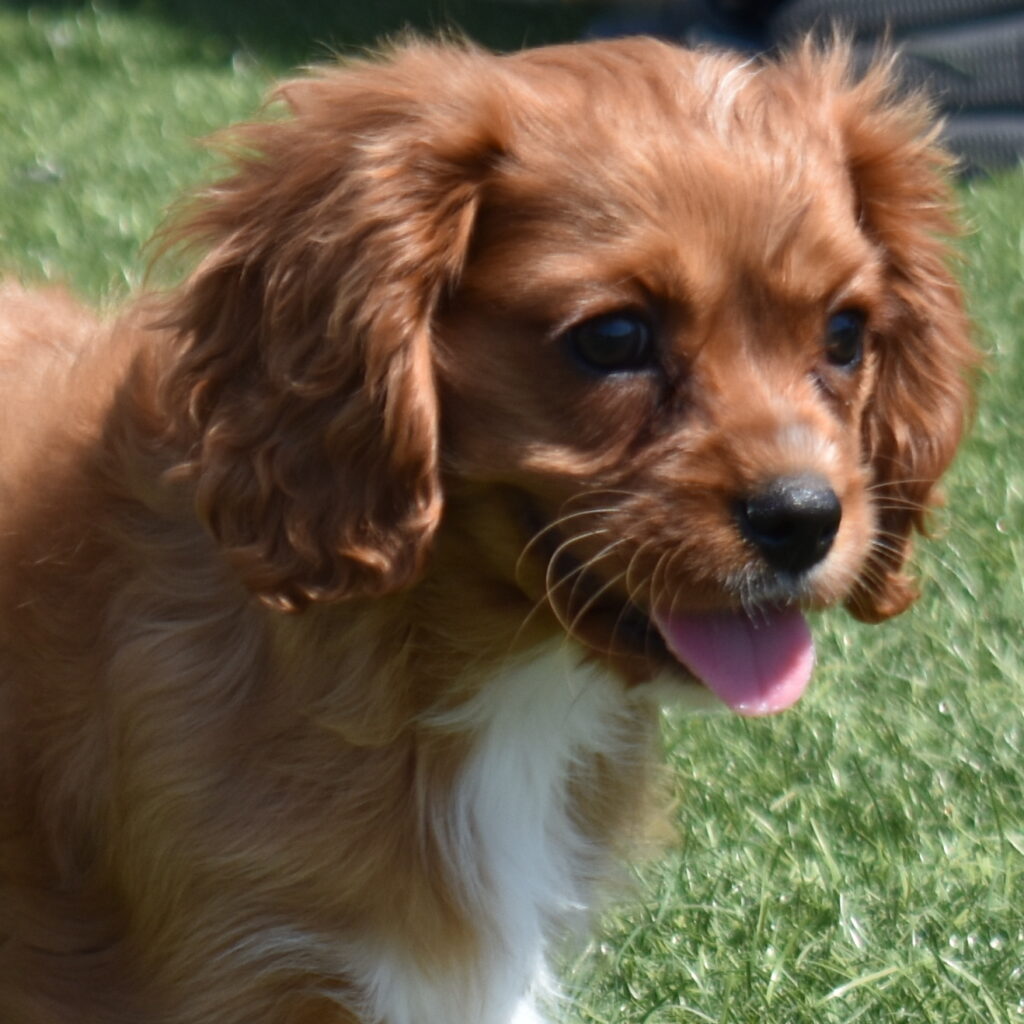
The breed standard calls for the Ruby to be a rich, whole-colored chestnut red. That sentence is deceptively simple for what it describes in practice.
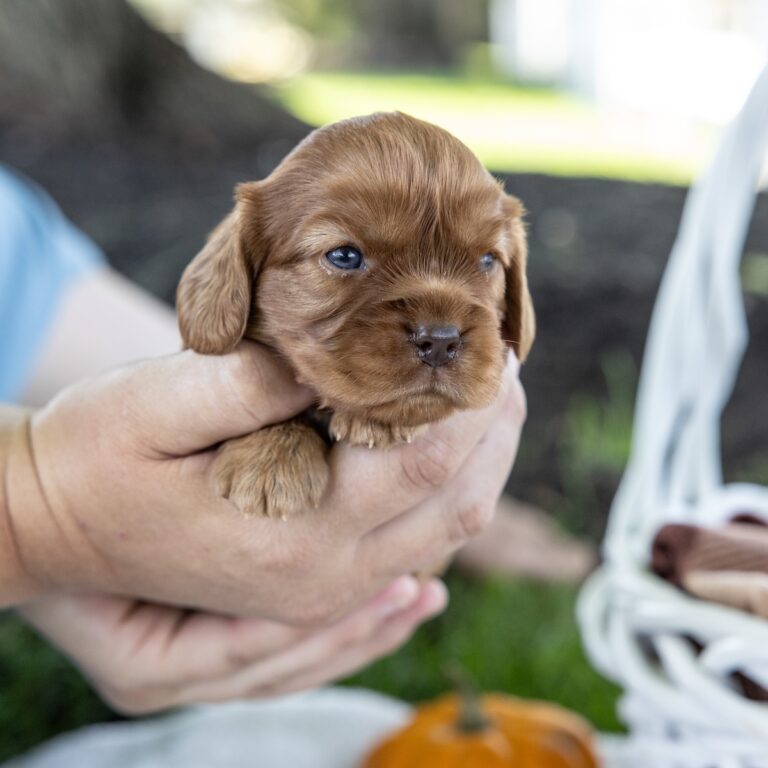
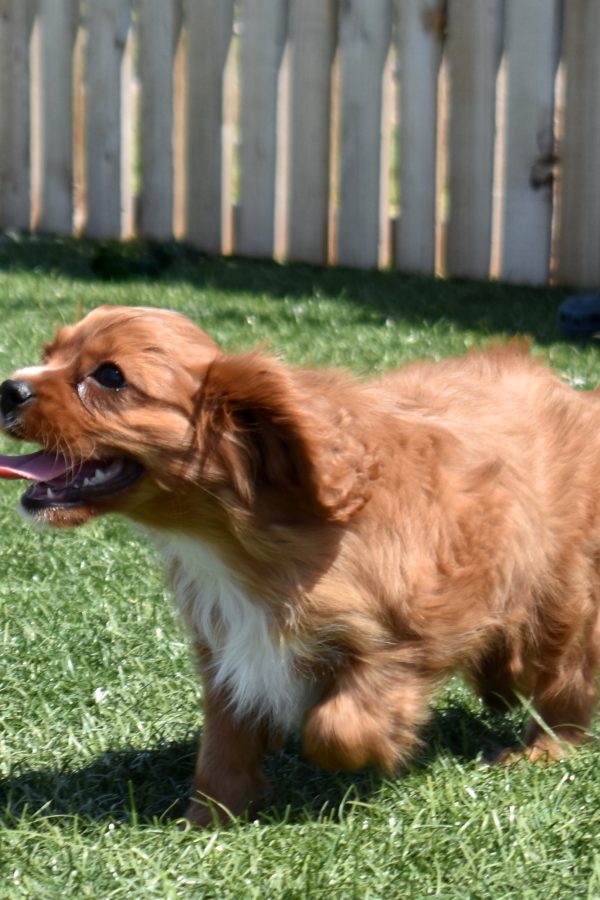
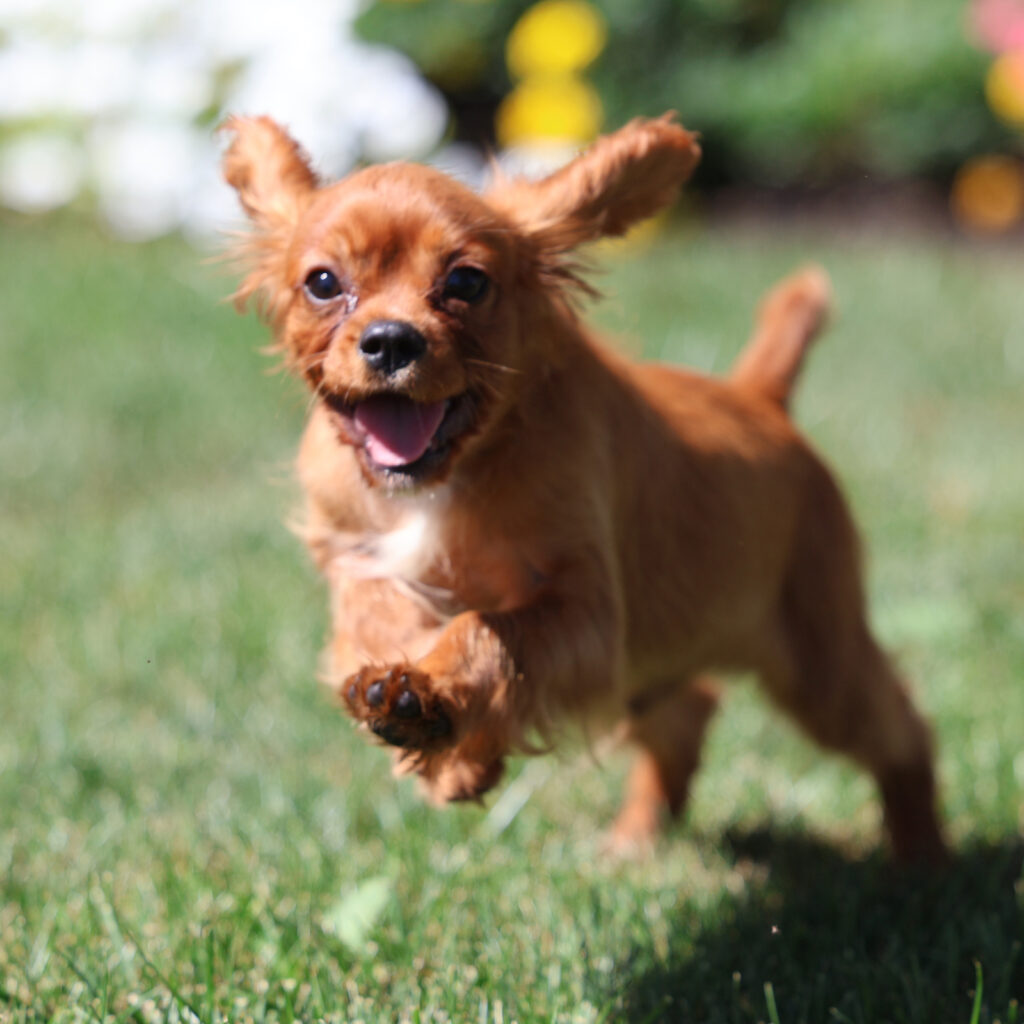
A Ruby is a solid-coated dog. No white on the chest, no white on the toes, no white blaze on the face, no parti-color pattern of any kind. The coat runs continuously from one end of the dog to the other in a single, unbroken expression of warm red. Against the silky, feathered coat typical of the Cavalier — with its longer fringing on the ears, chest, legs, and tail — the effect is something like a single sustained note of color. Rich, warm, and deeply even.
The shade of that red varies between individuals and between lines. Some Rubies carry a lighter, brighter red that sits closer to a deep auburn. Others carry a darker, richer mahogany that has an almost burnished quality in good light. Both are correct. The standard calls for richness above all else — a coat that has depth and warmth rather than one that appears washed out or pale. A faded, strawberry-red Ruby is considered less desirable than one with a vivid, deep expression of color, though in practice the difference between a slightly lighter and a slightly darker Ruby matters far less to most families than the depth and health of the individual dog.
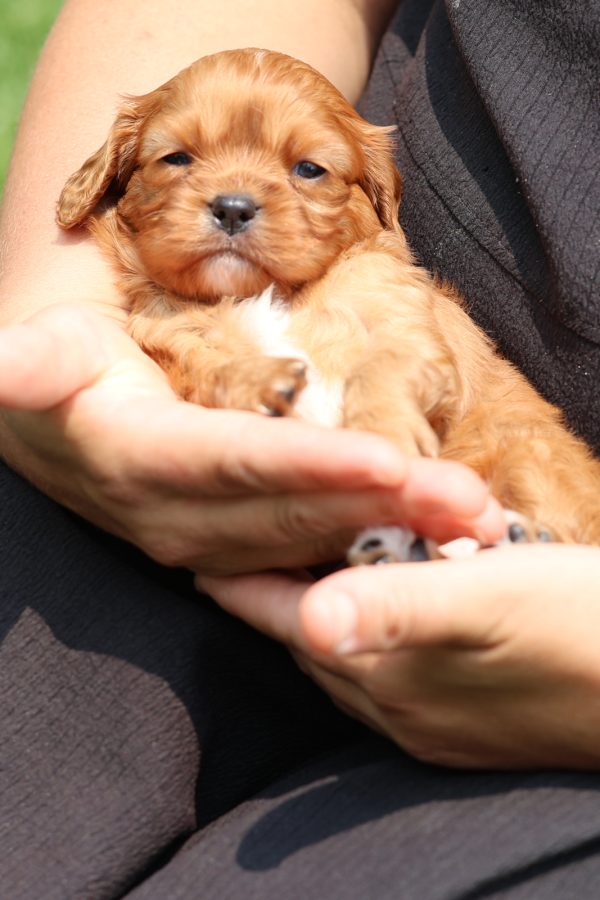
One thing worth knowing: Ruby color often deepens with age. Many Ruby puppies that appear relatively light at eight weeks will develop into dramatically richer adults by the time they are two or three years old. This is one of the reasons experienced Ruby breeders encourage buyers not to judge a young puppy’s color too harshly — the coat is still becoming what it will be.
What "Whole Color" Actually Means
The distinction between whole colors and parti-colors in the Cavalier is more meaningful than it might appear at first.
Blenheim and Tricolor are both parti-colors — patterns where white combines with one or more other colors in a broken, patchy distribution. The white is a fundamental part of the pattern, not an absence of color but an active genetic element that divides the coat.
Ruby and Black and Tan are whole colors. The coat is continuous and unbroken by white. In the Ruby, this means an uninterrupted sweep of red from head to tail. In the Black and Tan, it means a black coat with precisely placed tan points, again without white entering the picture.
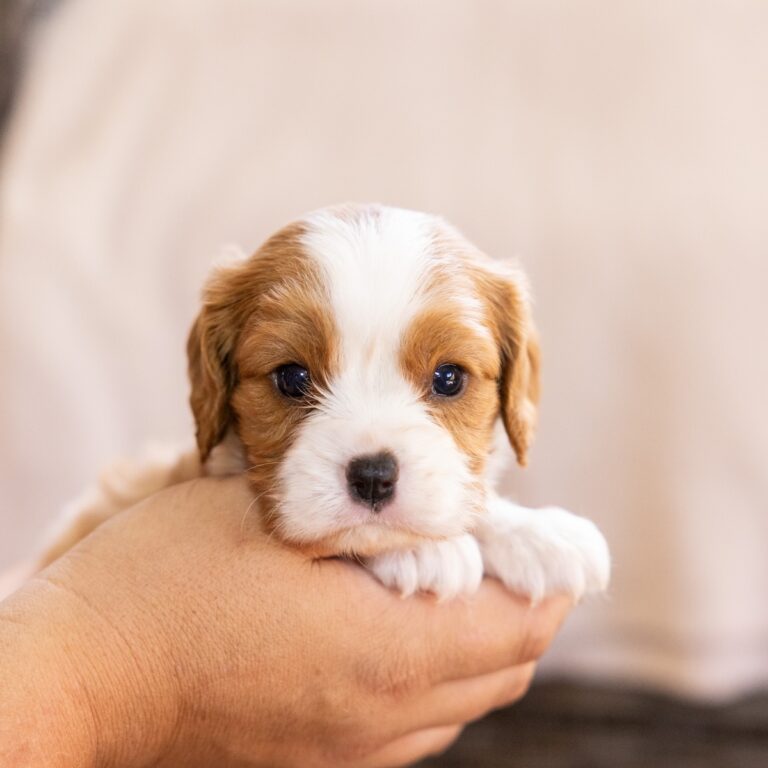
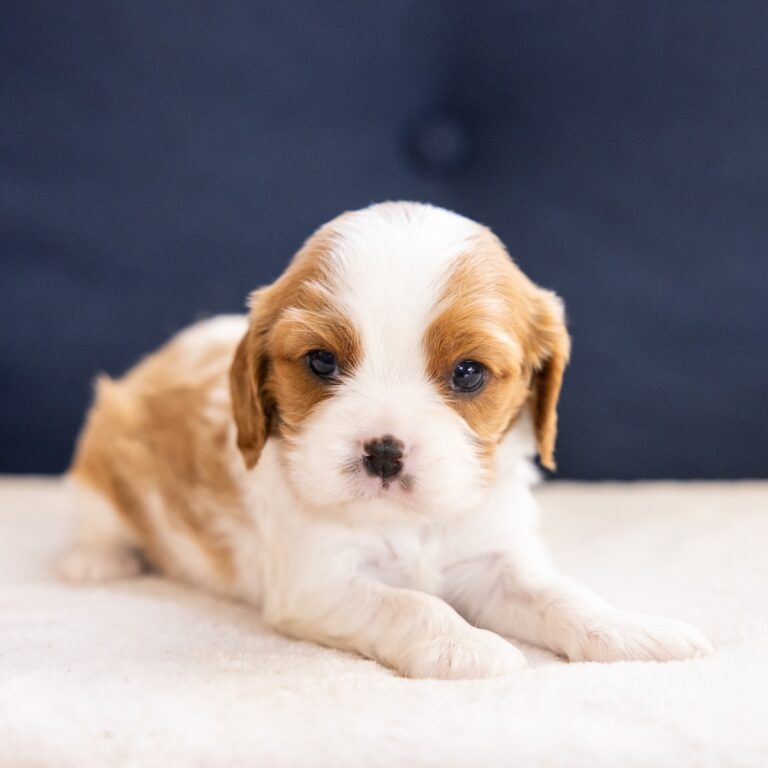
The practical implication of whole color for the Ruby is that any white appearing in the coat is considered a fault in the show ring. Small amounts of white — a few hairs on the chest, a small patch on a toe — are not uncommon in some Ruby lines and are sometimes referred to informally as “blenheim marking,” a reference to the underlying genetic relationship between the Ruby and the Blenheim. Dogs with visible white are disqualified from showing but are in every other respect completely normal, healthy, beautiful Cavaliers. Many families actually prefer a Ruby with a small chest star — they find it charming — and it has no bearing on temperament or health whatsoever.
The Genetics Behind The Ruby Color
The Ruby and the Blenheim are, from a genetics standpoint, more closely related than they appear. Both are produced by the same underlying mechanism at the E locus: two copies of the recessive “e” allele, which blocks the production of eumelanin (black pigment) and allows only phaeomelanin (red/yellow pigment) to express. This is why both colors result in a warm, reddish coat rather than a black one — neither the Ruby nor the Blenheim can produce black pigment in their coats at all.
What separates them is the S locus — the gene that controls the distribution of white in a coat. Blenheims carry the parti-color pattern, meaning the S locus introduces white into the coat in patches. Rubies do not carry this pattern; their S locus produces a whole-color coat, and red expresses continuously across the entire dog.
This genetic relationship has a practical consequence for breeding: Ruby and Blenheim matings are common, and it is entirely possible for such a pairing to produce both Ruby and Blenheim puppies in the same litter depending on the parents’ individual S locus genotypes. A Ruby that carries one copy of the parti gene can produce Blenheim puppies; a Ruby that is homozygous for whole color will produce only whole-colored offspring when bred to another whole-color dog. This is part of why some Ruby lines occasionally throw puppies with small white markings — the parti gene is present but not fully expressing.
None of this has any health implications. It is simply the mechanics of how color inheritance works, and understanding it can help buyers make sense of what they see in litter photos and sibling comparisons.
What To Look For In A Well-Bred Ruby Puppy
Because Ruby Cavaliers are rarer than Blenheims, the pool of breeders who produce them regularly is smaller. That rarity cuts both ways. On one hand, it means you may need to wait longer and look harder to find a well-bred Ruby. On the other, it means that breeders who specialize in or regularly produce Rubies tend to be genuinely invested in the color in a way that correlates with careful, committed programs.
As with any Cavalier color, the health foundation matters far more than anything else. The Cavalier is a breed with known, serious health concerns — most significantly mitral valve disease (MVD) and syringomyelia (SM). Any responsible Cavalier breeder should be able to provide cardiac clearances performed by a board-certified cardiologist, MRI clearances for SM in the parent dogs, and current eye and hip certifications. These requirements are the same regardless of color, and a breeder who cannot or will not provide this documentation is not a breeder worth considering, however beautiful their Rubies may be.
On the color side, you are looking for depth and richness in the coat. A well-bred Ruby should have a coat that reads as genuinely red — warm, saturated, alive — rather than pale or faded. White hairs, if present in small amounts, are cosmetic and not a health concern, but a heavily white-marked Ruby is unusual enough to prompt questions about the breeding.
Pay attention to how the color sits against the coat’s texture. The silky, feathered quality of the Cavalier coat is part of what gives the Ruby its particular glow — a coarse or flat coat texture diminishes the color in the same way that poor fabric diminishes a deep dye. A Ruby whose coat has the right texture, length, and sheen will look visually different from one that doesn’t, and a good breeder will have developed an eye for this.
Finally: be patient. Ruby puppies are not always available when you want them. A reputable breeder may have a waitlist, and that waitlist is worth joining. The right Ruby from the right program is worth the wait in a way that is genuinely hard to overstate once you have the dog.

Does Color Affect Temperament? The Honest Answer
The answer is the same for Rubies as it is for all four Cavalier colors: no.
There is a persistent piece of internet folklore that Rubies are more independent, more cat-like, or slightly less velcro-dog than the parti-colors. We have seen this claim repeated enough times that it is worth addressing directly: there is no documented evidence for this. Individual Cavaliers vary enormously in personality, and that variation is driven by genetics (the specific dogs in the lineage), socialization during puppyhood, and the individual temperament of the dog — not the color of the coat.
What you can say with confidence about any well-bred Cavalier, Ruby or otherwise, is that the breed was designed from the ground up for human companionship. These are dogs that want to be with their people. They are gentle, affectionate, and remarkably good at reading the emotional temperature of a room. They tend to be wonderful with children and with seniors, and they carry a softness that makes them therapeutic in the truest sense of the word. That character is a function of breed and breeding, not color — and it is, ultimately, the reason people who own one Cavalier so often end up with two or three.
How The Ruby Compares To The Other Three Colors
For those still navigating the color conversation, it helps to understand where the Ruby sits in relation to the other three.
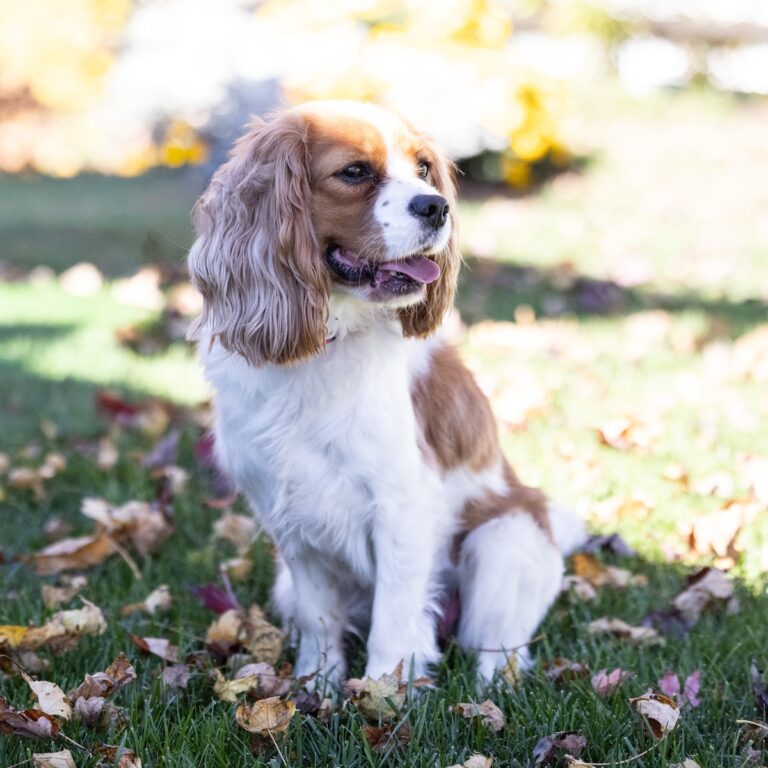
Against the Blenheim, the Ruby is its whole-color counterpart — the same underlying genetic base, a different coat pattern. The Blenheim offers visual variety and the particular pleasure of markings: the interplay of white and chestnut, the symmetry of patches, the possibility of a Blenheim spot. The Ruby offers something different: purity and depth. A single, unbroken coat that rewards close attention and grows more beautiful with age. People drawn to the Blenheim tend to love the richness of the chestnut against the white. People drawn to the Ruby tend to love the richness of the red as itself — unmediated, with nowhere to hide.
Against the Tricolor, the contrast is warmth versus drama. A Tricolor is a high-contrast dog — jet black, bright white, vivid tan points, crisp and formal and striking. The Ruby is the opposite of high-contrast: a single warm color, subtle in its visual complexity, growing on you the longer you look. Both are extraordinary. The choice between them is almost entirely a question of aesthetic temperament.
Against the Black and Tan, the Ruby shares the whole-color quality — no white, continuous coat — but the two colors produce very different impressions. The Black and Tan has a precise, almost tailored elegance: that rich black against those perfectly placed tan points is quietly sophisticated in a way that surprises people. The Ruby is warmer and more approachable in its visual effect, less formal, more immediately inviting. Both are underappreciated relative to the parti-colors, and both deserve far more attention than they typically get.
Why Families Choose The Ruby
The people who choose Ruby Cavaliers are, in our experience, a particular kind of buyer. They tend to have done their research. They know what they are looking for, they have thought carefully about it, and they have arrived at the Ruby not by default but by genuine preference. That deliberateness tends to mean that Ruby owners are among the most devoted Cavalier enthusiasts we encounter — they chose the harder road to get to this dog, and they appreciate it all the more for that.
But beyond the deliberateness, the Ruby earns that devotion on its own terms. There is something about living with a well-bred Ruby — watching that coat change and deepen over the first two or three years, noticing the way it catches light differently at different times of day, seeing the way strangers stop and ask about the dog — that creates a kind of attachment that is genuinely hard to articulate. The Ruby is not a color that announces itself from a distance. It is a color that reveals itself the closer you get.
That quality — depth that rewards proximity — is entirely fitting for a breed whose greatest gift is exactly the same.
Ready To Find Your Ruby Cavalier?
At Villa Crest Puppies, our Ruby Cavaliers are bred with the same commitment to health testing, temperament, and careful socialization that defines everything we do. We believe the Ruby deserves the same rigorous foundation as any other Cavalier color — and that a family who falls in love with a Ruby deserves to know that the dog they are bringing home was raised with as much care for what is on the inside as for what glows on the outside.
If you are considering a Ruby Cavalier King Charles Spaniel, we would love to talk with you. Reach out to start a conversation about our program, our current and upcoming litters, and what you can expect from the experience of bringing one of these remarkable dogs home.

Written By: Villa Crest Puppies
Villa Crest Puppies is dedicated to raising healthy, well-socialized companion dogs with a passion for responsible breeding. Committed to ethical practices and the highest standard of care, they take pride in matching each lovingly raised puppy with the perfect forever family.