




The Blenheim Cavalier King Charles Spaniel: A Complete Guide to the Breed’s Most Iconic Color
By Villa Crest Puppies
There is a reason that when most people close their eyes and picture a Cavalier King Charles Spaniel, they see a Blenheim. Rich chestnut and pearly white. Warm, luminous markings against a soft ground coat. A face framed in color that feels almost painted. The Blenheim is not merely the most popular Cavalier color — it is the one that has, in many ways, come to define the breed in the public imagination. And yet, for all its familiarity, the Blenheim rewards closer attention in ways that most people never fully explore.
This guide is a deep dive into everything that makes the Blenheim Cavalier King Charles Spaniel so enduringly beloved. We will cover the history behind the color and its name, what the ideal Blenheim looks like and how markings vary, the genetics that produce this pattern, what to look for in a well-bred Blenheim puppy, and the honest answers to questions that prospective buyers ask us most often. If you are considering a Blenheim Cavalier, or simply want to understand this color at a deeper level, this is the guide for you.
Navigation
Article Contents
Where the Name “Blenheim” Comes From
The name Blenheim does not refer to a color in the abstract — it refers to a place. Blenheim Palace, the grand English country house in Oxfordshire, is the ancestral seat of the Dukes of Marlborough, one of Britain’s most storied aristocratic families. The first Duke of Marlborough, John Churchill, was among the most celebrated military commanders in British history, and his family maintained a long tradition of breeding chestnut and white spaniels on the palace grounds.
The connection between the Marlborough family and this specific color is old enough that the chestnut-and-white combination became synonymous with their breeding program long before the modern Cavalier breed was formally re-established in the twentieth century. When breeders began working to restore the long-nosed royal spaniel type in the 1920s and 1930s — a project inspired in part by Roswell Eldridge’s famous prize at Crufts — the chestnut and white color retained its aristocratic name. Today, every Blenheim Cavalier carries that name as a quiet nod to centuries of British history.
It is one of the things that makes the Cavalier King Charles Spaniel unusual among dog breeds: its colors are not merely descriptive but historical. When you bring home a Blenheim, you are, in a small way, bringing home a piece of that lineage.
What a Blenheim Cavalier Actually Looks Like
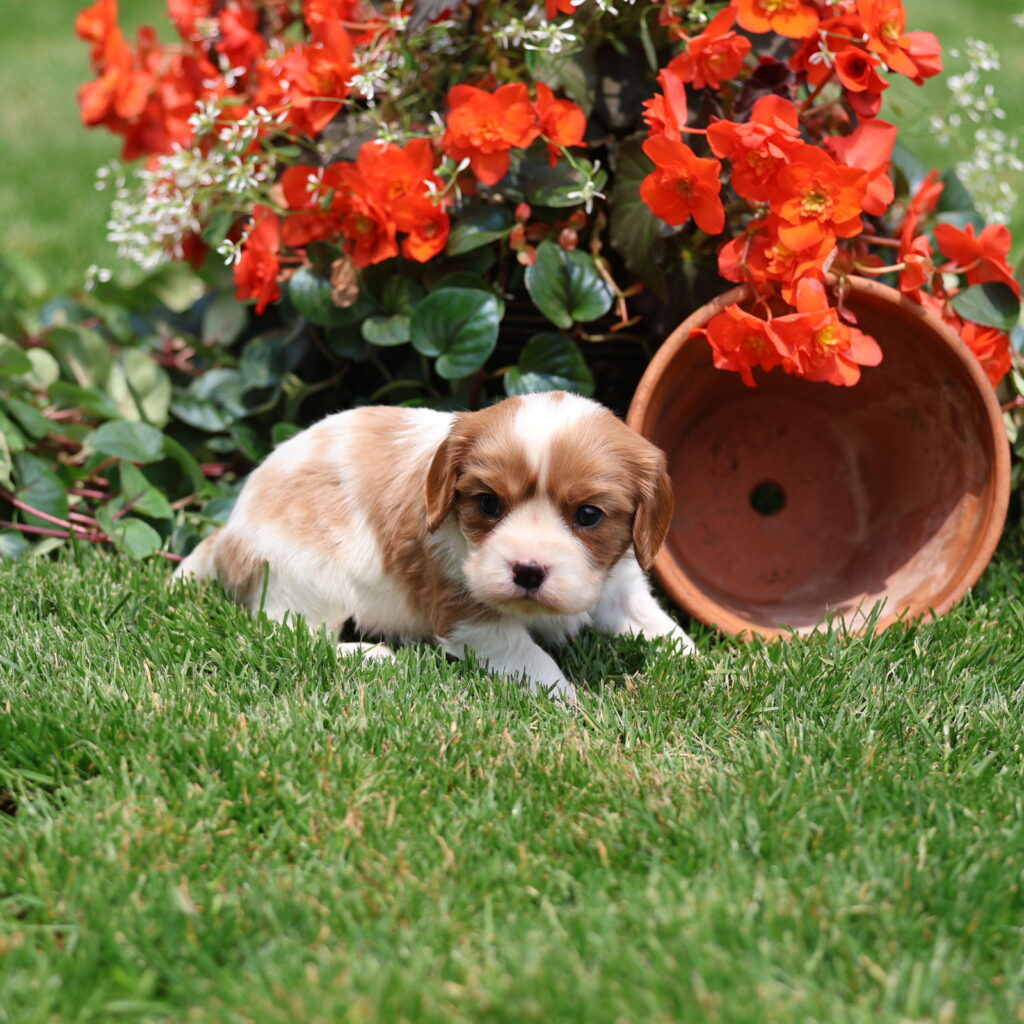
The breed standard describes Blenheim as rich chestnut markings, well broken up, on a pearly white ground. That phrase — pearly white ground — is worth dwelling on. The white in a well-marked Blenheim is not simply white. It has a softness and luminosity to it that photographs struggle to capture fully, a quality that makes the chestnut markings appear to float against the coat rather than sit on top of it.
The chestnut itself can range considerably in tone. Some Blenheims carry a lighter, golden-chestnut that feels almost honey-colored in certain light. Others carry a deep, warm mahogany that is so rich it borders on auburn. Both are correct and both are beautiful. What matters to breeders and to the breed standard is not the precise shade of chestnut but its depth, clarity, and distribution across the coat.
In terms of distribution, ideal markings are symmetrical and well-balanced. Chestnut patches over both ears, extending to frame the face, with a clear white blaze running up through the center of the skull. The body carries chestnut patches as well, with the degree of coverage varying from dog to dog. Some Blenheims are quite heavily marked, with large chestnut patches on the back and sides. Others are more lightly marked, with smaller, more scattered patches against a predominantly white body. Neither is objectively better than the other, though personal preference plays a strong role in what people find most appealing.


The Blenheim Spot: History, Legend, and Reality
No discussion of the Blenheim Cavalier is complete without addressing the Blenheim spot — the small, lozenge-shaped chestnut marking that appears on the top of the skull between the ears on some individuals. In the show ring it is considered a mark of distinction, and among enthusiasts it is one of those details that can become almost an obsession.
The legend behind the spot is one of the more charming stories in dog breeding folklore. It holds that Sarah Churchill, the Duchess of Marlborough, was waiting anxiously at Blenheim Palace for news of her husband’s campaign at the Battle of Blenheim in 1704. During that long wait, she is said to have pressed her thumb repeatedly against the head of a pregnant spaniel — and that the pressure of her thumb left a permanent impression that has been passed down through generations of Blenheim Cavaliers ever since.
The genetics behind the spot are, of course, rather more prosaic than the legend. The lozenge marking is simply a pattern of pigmentation that some Blenheims carry and others do not. Its presence or absence has absolutely no bearing on the dog’s health, temperament, or quality as a companion. A Blenheim without the spot is in no way inferior to one that has it. But for those who love this color deeply, spotting a well-placed Blenheim spot on a puppy is one of those small, particular pleasures that makes the whole thing feel a little magical.
The Genetics Behind the Blenheim Color
Understanding how the Blenheim color is produced requires a brief primer on canine color genetics — not because you need to become an expert, but because it helps explain some things that might otherwise seem puzzling when you are looking at litters and puppies.
Blenheim is a parti-color pattern, meaning it features two colors — white and chestnut — in a broken, patchy distribution. The white in a parti-color dog is produced by the S locus (the “piebald” gene), which essentially removes pigmentation from portions of the coat, leaving white. The chestnut color itself is produced by the combination of an “ee” genotype at the E locus — meaning the dog carries two copies of the recessive “e” allele, which prevents the production of black pigment and results in a red or chestnut expression of whatever underlying color the dog carries.
What this means in practice is that a Blenheim Cavalier cannot carry hidden black pigment in its coat — it is genetically incapable of producing black. This is why Blenheims cannot naturally produce Tricolor or Black and Tan puppies from their own color alone. Two Blenheim parents will always produce Blenheim puppies (or in some cases parti-color puppies with very similar genetics). The chestnut color may vary in intensity between individuals, but the fundamental color pattern is locked in at the genetic level.
It also explains why the chestnut shade can vary so significantly between Blenheims from different lines. Modifier genes influence how deep or light the chestnut expresses, which is why you can have two beautifully marked Blenheims where one is a golden honey-chestnut and the other is a deep mahogany — both correct, both lovely, both Blenheim.
What to Look for in a Well-Bred Blenheim Puppy
Because Blenheims are the most common Cavalier color, there is more variation in quality among Blenheim breeders than with the rarer colors. That means buyers need to be particularly thoughtful, and it means that the questions you ask and the things you look for matter more than they might with a Ruby or a Black and Tan, where the pool of breeders is naturally smaller.
The most important things have nothing to do with color at all. Health testing is the foundation of responsible Cavalier breeding, and it is non-negotiable regardless of color. Cavaliers are a breed with known health concerns — most significantly mitral valve disease (MVD) and syringomyelia (SM), a neurological condition caused by the skull’s relationship to the brain and spinal cord. Any responsible Cavalier breeder, of any color, should be able to show you evidence of cardiac clearances on both parents performed by a board-certified cardiologist, MRI clearances for SM, and current eye and hip certifications. If a breeder cannot or will not provide this documentation, that is a serious red flag.
On the color side specifically, you are looking for markings that are clean and well-defined. Chestnut that is muddy, faded, or patchy in an unbalanced way is a sign of less careful breeding. The white ground should be bright and clear, without a yellowish or dingy cast. Symmetry in the facial markings — balanced patches over both ears, a clean blaze — is a hallmark of quality. And the chestnut should be rich rather than washed out, whatever shade it falls on the spectrum from golden to mahogany.
Markings will continue to develop after birth. Newborn Blenheims can look quite different from how they will appear at eight weeks, and eight-week-old Blenheims will look somewhat different from their adult selves. A good breeder can give you a sense of how markings tend to develop in their lines, and can help you understand what you are seeing at the age you are visiting.

Does Color Affect Temperament? The Honest Answer
This question comes up in every color conversation, and the answer for Blenheims is the same as it is for all four Cavalier colors: no. There is no documented relationship between coat color and temperament in the Cavalier King Charles Spaniel. Blenheims are not calmer, more energetic, more affectionate, or more stubborn than Tricolors, Rubies, or Black and Tans. The gentle, people-oriented, companionable temperament that defines the breed is a function of genetics, socialization, and the quality of the breeding program — not the color of the coat.
We mention this because the internet is full of anecdotal claims about color and personality — that Rubies are more independent, that Tricolors are more energetic, that Blenheims are the most laid-back. These claims are not supported by evidence and should be taken with a healthy dose of skepticism. Individual dogs vary enormously in personality, and that variation is driven by factors that have nothing to do with color.
What you can say with confidence about the Cavalier King Charles Spaniel regardless of color is this: it is a breed built for companionship. These are dogs that want to be near their people, that thrive on closeness and affection, and that carry a remarkable gentleness that makes them wonderful with children, seniors, and everyone in between. That character is consistent across all four colors and is, ultimately, the reason people fall so deeply in love with this breed.
How the Blenheim Compares to the Other Three Colors
For those who are still making up their minds between colors, it helps to understand how the Blenheim sits in relation to the other three recognized varieties. The Cavalier colors divide into two natural pairs: parti-colors (Blenheim and Tricolor) and whole colors (Ruby and Black and Tan). The Blenheim and Tricolor share the white-and-secondary-color parti pattern, while the Ruby and Black and Tan are continuous, non-white coats.
Against the Tricolor, the Blenheim’s warmth is its distinguishing quality. A Tricolor’s jet black and white with tan points has a crispness and formality to it — beautiful in a sharp, high-contrast way. The Blenheim is warmer, softer, more approachable. The chestnut glows where the black of a Tricolor commands. Both are stunning. The choice between them often comes down to whether you are drawn to warmth or to drama.
Against the Ruby, the contrast is in complexity versus purity. A Ruby’s coat is a single, unbroken sweep of rich red — deeply beautiful in its simplicity, with a depth that rewards close attention. The Blenheim offers more visual variety, the interplay of two colors and the particular pleasure of markings. People who love the Blenheim tend to love that variation. People who love the Ruby tend to love the intensity of a coat with nowhere to hide.
Against the Black and Tan, the Blenheim is the more approachable, the more familiar. The Black and Tan is genuinely underappreciated — a dog with more historical gravitas and a quietly sophisticated presence that surprises people who see one for the first time. The Blenheim wins on immediate recognition and warmth. The Black and Tan wins on rarity and that quiet, earned elegance.
Why So Many Families Choose the Blenheim
The Blenheim is the most popular Cavalier color for reasons that go beyond simple familiarity, though familiarity is certainly part of it. When people first encounter the breed, it is almost always a Blenheim they see — in photographs, on social media, in the arms of someone who stops to let you pet their dog on the street. That first impression is a powerful one, and it shapes how people understand the breed.
But the Blenheim also has qualities that are genuinely, objectively appealing on their own terms. The warmth of the chestnut against the white has a timeless quality — it is a color combination that has been considered beautiful for centuries, and that opinion has not changed. There is something about the way a Blenheim’s face is framed by chestnut — the way the markings draw attention to those large, dark, expressive eyes — that is uniquely compelling in a way that is hard to articulate but impossible to miss.
There is also, for many families, something meaningful in the historical depth of the color. Choosing a Blenheim means choosing a color that has been associated with this breed since its aristocratic origins, that carries the name of one of England’s most famous palaces, that connects the dog in your lap to something much older and grander than either of you. That is not a trivial thing. History is woven into the coat.
Ready to Find Your Blenheim Cavalier?
At Villa Crest Puppies, our Blenheim Cavaliers are bred with the same commitment to health testing, temperament, and careful socialization that defines everything we do. We believe that the beauty of a Blenheim coat should sit on a foundation of genuine health and genuinely good breeding — and that every family who chooses a Blenheim deserves to know that the dog they are bringing home was raised with as much care for what is on the inside as for what shows on the outside.
If you are considering a Blenheim Cavalier King Charles Spaniel, we would love to talk with you about our program, our current and upcoming litters, and what you can expect from the experience of bringing one of these remarkable dogs home. Reach out to start a conversation — we are always happy to answer questions, share what we know, and help you take the next step toward your perfect match.

Written By: Villa Crest Puppies
Villa Crest Puppies is dedicated to raising healthy, well-socialized companion dogs with a passion for responsible breeding. Committed to ethical practices and the highest standard of care, they take pride in matching each lovingly raised puppy with the perfect forever family.