




Cavalier King Charles Spaniel Colors: An Honest Guide to All Four Varieties
By Villa Crest Puppies
Ask most people what a Cavalier King Charles Spaniel looks like and they will describe a Blenheim — that warm chestnut and white combination that has become almost synonymous with the breed itself. And while the Blenheim is undeniably beautiful, it represents only one quarter of the story. The Cavalier King Charles Spaniel comes in four distinct colors, each one with its own history, its own visual character, and its own devoted following. At Villa Crest Puppies, we are fortunate enough to work with all four, and after years of placing these dogs with families, I can tell you honestly that the color conversation is one of the most interesting ones we have. This guide is my attempt to give you a thorough, honest, and genuinely useful look at all four Cavalier King Charles Spaniel colors — not just what they look like, but what makes each one special, where they come from, and what you should know before you fall in love with one.
Navigation
Article Contents
A Brief History: Why the Cavalier Comes in Four Colors
To understand Cavalier King Charles Spaniel colors, it helps to understand a little of the breed’s remarkable history. The small spaniel companions favored by British royalty in the 16th and 17th centuries came in a variety of colors and patterns. King Charles II, for whom the breed is named, was famously devoted to his black and tan spaniels — so devoted, in fact, that a royal decree was issued allowing the dogs entry into any public building in England, a ruling that some claim technically remains on the books to this day.
Over the following centuries, breeding practices shifted toward a flatter-faced, domed-skull appearance that diverged significantly from the original spaniel type. It wasn’t until the 1920s that an American named Roswell Eldridge offered prize money at Crufts for anyone who could produce a dog resembling the long-nosed spaniels in old royal portraits. That effort eventually led to the re-establishment of what we now call the Cavalier King Charles Spaniel — a dog that more closely resembles its aristocratic ancestors than the shorter-faced King Charles Spaniel that had become dominant.
Throughout that history, all four colors were present. The breed standard recognizes Blenheim, Tricolor, Ruby, and Black and Tan as the only acceptable colors, and each has its own distinct genetic origin and visual identity. Understanding that history gives you a deeper appreciation for why color in this breed is not just a cosmetic consideration — it is woven into the very fabric of what the Cavalier is.
The Four Cavalier King Charles Spaniel Colors at a Glance
Before we go deep on each individual color, it is worth framing them together. The four recognized Cavalier King Charles Spaniel colors divide naturally into two pairs. Blenheim and Tricolor are both parti-colors — meaning they feature white as a significant part of the coat combined with other colors. Ruby and Black and Tan are both whole colors — solid or near-solid coats without white markings.
This distinction matters more than most people realize. The two parti-colors tend to be more visually striking at first glance — the contrast between white and the secondary color creates an immediately eye-catching appearance. The whole colors, particularly Ruby, have a depth and richness that rewards closer attention and often grows more beautiful with age. Neither category is objectively superior. They are simply different expressions of the same magnificent breed.
What all four colors share is the same gentle, expressive face — those large, round, dark eyes that give the Cavalier its characteristic look of warmth and intelligence, and that silky, feathered coat that feels as beautiful as it looks. Color sits on top of all of that like a final, personal touch. It is the first thing you notice and often the thing you remember. But it is never the most important thing about a Cavalier.

Blenheim: The Classic, The Icon, The Standard-Bearer
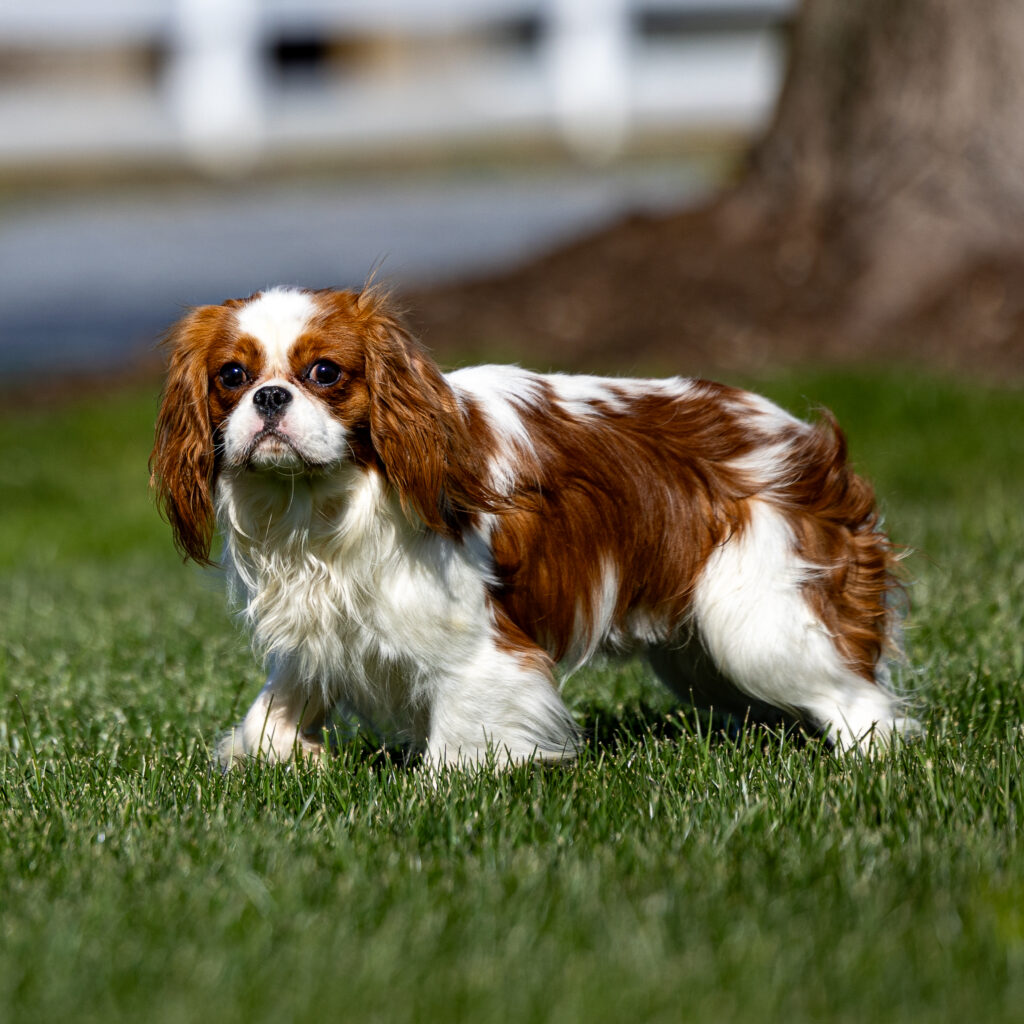
If the Cavalier King Charles Spaniel has a signature look, it is the Blenheim. Rich chestnut markings on a pearly white ground — the combination is instantly recognizable and has been associated with this breed for centuries. The name itself comes from Blenheim Palace, the ancestral home of the Duke of Marlborough, whose family bred chestnut and white spaniels for generations. Legend holds that the Duchess of Marlborough pressed her thumb against the head of a pregnant spaniel while awaiting news of her husband’s battle, leaving a permanent thumbprint mark that is said to explain the distinctive lozenge-shaped spot — the Blenheim spot — that appears on the forehead of many Blenheims between the ears.
Whether or not you believe the legend, the Blenheim spot is real, highly prized, and considered a mark of distinction in the show ring. Not every Blenheim has one, and its presence or absence has no bearing whatsoever on the dog’s temperament or quality as a companion. But for those who love the Blenheim, the spot is one of those details that makes this color utterly special.
Blenheims are by far the most common Cavalier King Charles Spaniel color, which means they are also the easiest to find and often the most familiar to prospective buyers. That familiarity should not be confused with ordinariness. A beautifully marked Blenheim with rich, even chestnut patches and a clear white ground is a genuinely stunning dog. The chestnut can range from a lighter golden tone to a deep, warm mahogany, and the best examples have markings that are well-distributed and clearly defined.
At Villa Crest, our Blenheim Cavaliers carry the classic markings that have made this color beloved for centuries. If this is the color that first drew you to the breed, trust that instinct — there is a reason the Blenheim has captivated people for so long.
Ruby: The Rarest and Most Misunderstood
Ruby Cavaliers are the most misunderstood of the four Cavalier King Charles Spaniel colors, and I think that is largely because they are the most different from what most people picture when they think of this breed. A Ruby is a whole-colored Cavalier — meaning the coat is a rich, deep, solid red with no white markings whatsoever. No blaze, no white chest, no parti-color pattern. Just a continuous, luxurious sweep of warm mahogany from nose to tail.
The first time many people see a Ruby Cavalier in person, their reaction is something like surprised delight. They did not know this color existed, and then they see one and immediately understand why it has such a devoted following. The coat has a depth and warmth that photographs struggle to capture. In certain light, a Ruby Cavalier appears almost luminous — a rich, living auburn that catches the eye and holds it.
Ruby is the rarest of the four recognized colors, which means finding a well-bred Ruby from health-tested lines requires more patience and selectivity than finding a Blenheim. That rarity is part of the appeal for many Ruby enthusiasts, but it also means that buyers need to be particularly thoughtful about the breeders they consider. A reputable breeder who produces Ruby Cavaliers with the same health testing rigor as any other color is worth the wait.
One thing worth knowing about Rubies: white hairs or markings are considered a fault in the show ring, though they have absolutely no impact on the dog’s health or temperament. Some Rubies carry small amounts of white on the chest or toes — a characteristic known as ‘blenheim marking’ in the genetics — which disqualifies them from showing but makes them no less wonderful as companions. At Villa Crest, our Ruby Cavaliers are bred with the same health and temperament standards as every other color in our program.
Black and Tan: The Underrated Classic
If the Ruby is the most misunderstood Cavalier King Charles Spaniel color, the Black and Tan is arguably the most underrated. Like the Ruby, the Black and Tan is a whole color — a rich, glossy jet black coat with precise tan markings above the eyes, on the cheeks, inside the ears, on the chest, legs, and under the tail. The effect is elegant, sophisticated, and quietly stunning in a way that takes a moment to fully appreciate.
Black and Tan Cavaliers trace their lineage directly to the black and tan spaniels that King Charles II favored, making them arguably the most historically authentic expression of the breed. There is something genuinely moving about that connection — a dog that looks now much as it looked in 17th century royal portraits, unchanged in its essential character across four centuries.
The tan markings on a Black and Tan should be rich and clearly defined — a deep, warm golden-tan against the black, with the precision of placement that mirrors a well-marked Tricolor. The black itself should be true and glossy, without any brownish or rusty tinge. A beautifully marked Black and Tan is a breathtaking dog, and one that tends to turn heads in a different way than the more familiar Blenheim — people who recognize it often stop and stare, and people who have never seen one before often ask what breed it is.
Like the Ruby, Black and Tan is less common than the parti-colors, and finding quality examples requires a breeder who invests in this color with the same seriousness as any other. At Villa Crest, we believe the Black and Tan deserves every bit as much attention and care as the Blenheim, and we are proud to produce examples that reflect the very best of this classic color.


Tricolor: The Aristocrat of the Four
The Tricolor Cavalier King Charles Spaniel is, in my opinion, one of the most visually dramatic small dogs in existence. Jet black and bright white with rich tan markings over the eyes, on the cheeks, inside the ears, and under the tail — the combination is bold, precise, and utterly striking. Where the Blenheim is warm and inviting, the Tricolor has a crispness to it that feels almost formal, like a dog dressed for an occasion.
Tricolors were historically associated with King Charles II himself, who favored the black and white spaniels with tan points that appear in portraits of the era. The color combination has a long and aristocratic pedigree, and it shows. There is something inherently distinguished about a well-marked Tricolor — the clarity of the black against the white, the precision of the tan points — that gives these dogs a presence that is hard to look away from.
In terms of markings, the ideal Tricolor has a clear white blaze running up the center of the face between the eyes, well-defined black patches, and tan points that are vivid rather than washed out. The tan can fade slightly with age in some dogs, but a richly marked Tricolor puppy tends to mature into a richly marked adult.
Tricolors are less common than Blenheims but far from rare, and at Villa Crest we take particular pride in the quality and clarity of markings in our Tricolor litters. If you are drawn to high contrast, clean color definition, and that quietly aristocratic bearing — the Tricolor Cavalier King Charles Spaniel is a color worth considering very seriously.
Does Color Affect Temperament or Health?
This is the question I get asked most often in color conversations, and the answer is genuinely reassuring: no. Cavalier King Charles Spaniel color has no documented relationship to temperament or personality. Blenheims are not calmer than Rubies. Tricolors are not more energetic than Black and Tans. The gentle, affectionate, people-oriented temperament that defines this breed is consistent across all four colors and is a function of genetics, socialization, and breeding — not coat color.
On the health side, the same is true with one notable exception worth mentioning: there is some research suggesting that extreme white in certain breeds can be associated with hearing issues, but this is not a meaningful concern in Cavaliers, whose white markings are genetically distinct from the kind of extreme white seen in affected breeds. The health considerations that genuinely matter in Cavaliers — cardiac health, syringomyelia, hip and eye health — are entirely separate from color and should be the focus of any conversation with a responsible breeder.
The short version: choose your color based on what you love. The temperament and health foundation of your puppy will be determined by the quality of the breeding behind it, not by whether it is Blenheim, Tricolor, Ruby, or Black and Tan.
Which Cavalier King Charles Spaniel Color Is Right for You?
Honestly? The right color is the one you cannot stop thinking about. In my experience, people come in with an open mind and leave with a very clear preference — and that preference is almost always the right one. The heart knows what it wants, and with Cavaliers, trusting that instinct tends to lead to exactly the right match.
That said, if you are genuinely undecided, here is how I would frame it. If you want the classic Cavalier look that has been beloved for centuries, the Blenheim is your color. If you want something with more visual drama and crisp definition, the Tricolor is extraordinary. If you are drawn to something warmer and more unusual, the Ruby will stop you in your tracks. And if you want a dog with historical depth and quiet elegance that most people have never seen before, the Black and Tan is a revelation.
At Villa Crest Puppies, we work with all four Cavalier King Charles Spaniel colors because we believe each one deserves to be bred with the same care, the same health testing, and the same commitment to temperament that defines everything we do. Whether you are drawn to the iconic chestnut and white of a Blenheim or the deep, glossy richness of a Ruby, our goal is the same: to place a healthy, beautifully bred, wonderfully socialized Cavalier in a home that will love it for everything it is.
Explore our available Cavalier King Charles Spaniel puppies at Villa Crest Puppies, or reach out to start a conversation about upcoming litters. We would love to help you find your perfect color match.

Written By: Villa Crest Puppies
Villa Crest Puppies is dedicated to raising healthy, well-socialized companion dogs with a passion for responsible breeding. Committed to ethical practices and the highest standard of care, they take pride in matching each lovingly raised puppy with the perfect forever family.